Wednesday, June 2, 2010

THE TROOPER EXPERIENCE

I think it's all been decided as to what kind of vehicle we'll be getting for our Texas Fishing Truck project. First off, Billy Ray's fishing buddy Dan, who is my friend as well but I don't get to hang with him as much as I'd like, has had excellent luck with his early 90's Isuzu Trooper 4x4. Likewise, I've known several folks who put well in excess of 200k miles on their Troopers of this era.

Then I ran into a fellow at the Wal-Mart last week. He had a faded red Trooper, about a 1994, and I asked him how he liked it. He was an elderly retiree, and said he had bought it when he retired as a tow behind vehicle for his RV. Been using it ever since. He had thought on various occasions about getting other vehicles as a tow behind, like a CRV or an Element, which apparently are popular as tow behind RV vehicles. He said that he had not had any real problems with the Trooper and it was hard to sell a truck that wasn't giving you problems.

He said about a third of his miles were "tow behind" miles, and that he'd used his vehicle some for off-roading for fishing and hunting. He said it was light, powerful for what it was engine wise and that he had only gotten stuck once or twice. Although the paint was somewhat faded, you could tell the whole car was in great shape and it sounded strong when he cranked it up. Seems like most red Troopers I see of this age have the paint fade thing going on.

He wasn't interested in selling, but I got his name and gave him one of my cards.

Again, we have faith that providence will provide us with an ideal vehicle with which to base our Texas Fishing Truck on.

Ultimately, we'll run into someone we know, or who knows someone we know, who has an appropriate one or two owner vehicle for sale, with an honest maintenance history and relatively low miles for it's age.

Monday, May 31, 2010

FEATURES OF THE TEXAS FISHING TRUCK: PHASE ONE AND TWO

I'm going to keep this as a running idea thread for Billy Ray and I as far as what features and accessories we need to get fishing. Other ideas and hopefully some craigslist and ebay bargains might come along and how they might be incorporated.


We're not looking to make a head-turner or a boy racer here with the TFT, the Texas Fishing Truck. Function over form and style is the key thought. We'll be limited by budget, but I have a pretty good track record of finding and getting bargain items for all sorts of outside interests, and I have no doubt some of the things mentioned for phase two of the vehicle will come around at a good price sooner or later.


Phase One will be the immediate phase, once we buy the vehicle and the maintenance and things we need to get going on fishing trips immediately. It will be judicious and will include some vehicle improvements as we go. Of course, we'll be wanting to go fishing as soon as the TFT is roadworthy, and somewhere where we can do some thorough driving through some interesting conditions.


PHASE ONE


DOUBLE BATTERY-adding a battery to a 4X4 is good sense and cheaply done. Gives good backup power when out in the woods.


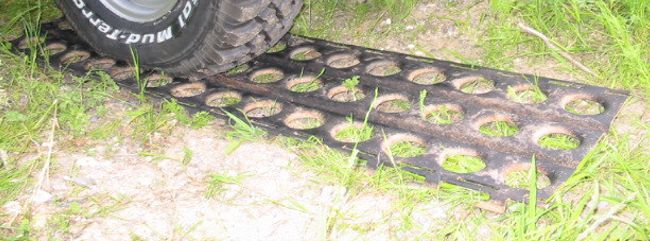
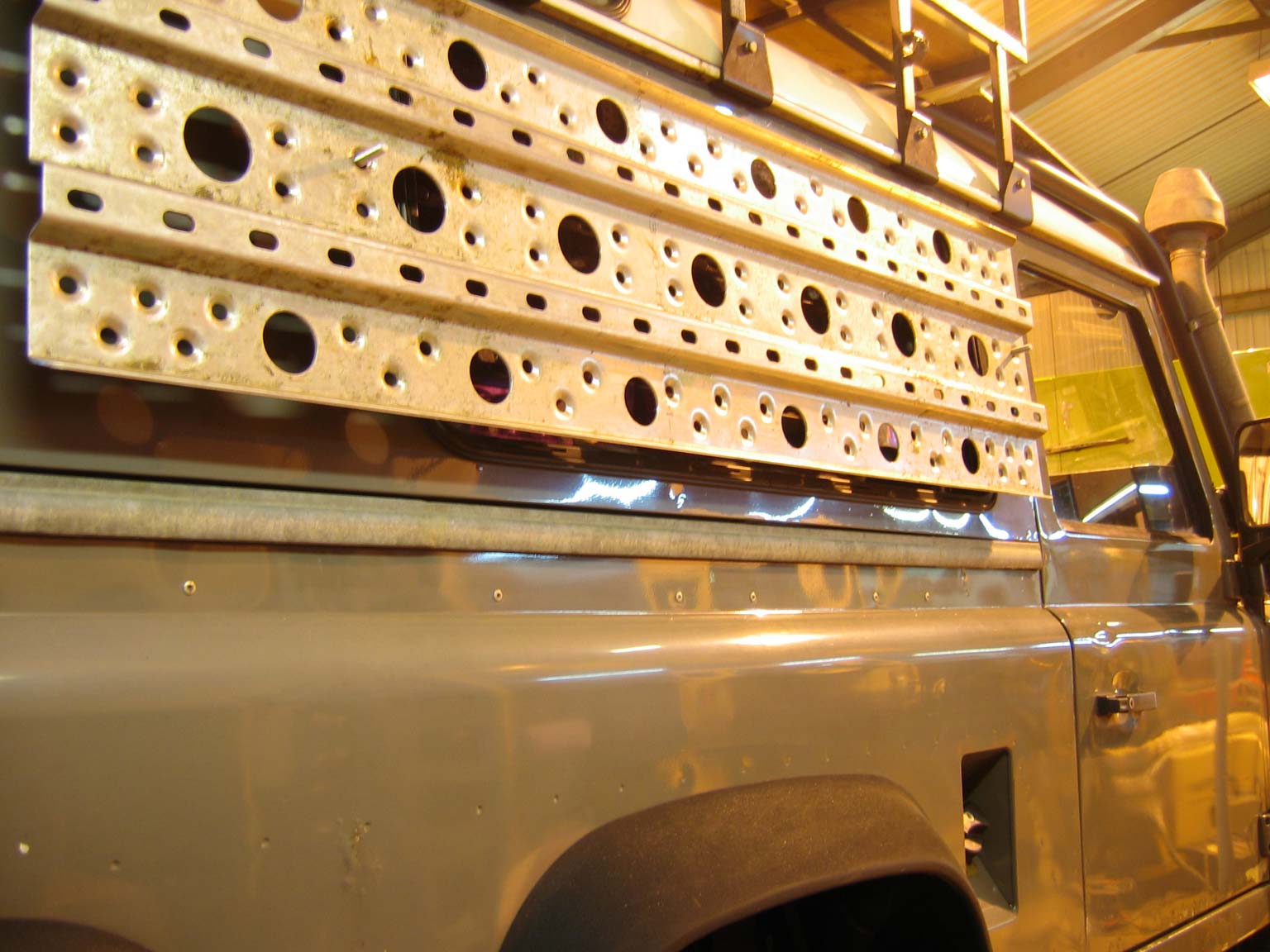
EXTRACTION GEAR: At the minimum, some shovels and high lift jack and tow straps/chains and a set of Sand Ladders. The Sand Ladders can be had for under $200, and you can throw them on the bottom of your roof rack mesh floor


ROOF RACK AND CARGO BASKET-Storage room. Places to put big stuff. Jerry cans with gas and water. Kayaks. Canoes. Small cartopper boats. A single space luggage carrier. Bikes. Boxes of camping gear. I'm pretty sure that part or all of the roof rack, attachments and basket can be found used at a decent savings. If we get lucky the vehicle we get will have some or all of this already. It will have some sort of metal mesh floor to support weight.

I've seen some rod racks for some different types of racks and baskets, and I've got a few ideas of my own for a stackable rod rack made with PVC tubing and which would mount as a stacking unit on a roof rack.

HITCH MOUNTED ROD RACK- For beach fishing, these are handy, and I'm inclined to have a welder friend make me one that I can plug in a square hitch just for beach fishing trips. It makes more sense to weld a square hitch receiver on the bottom of the front bumber, under a winch (Phase Two) and put the rod holders up front. Depending on how much weight you want to carry, you can have a removeable front or rear bumper rack that can carry large ice chests, generators, water and fuel (in the rear of vehicle, please) jerry cans and live wells.

I don't want to carry much at first, just a simple rod rack that mounts to the front of the vehicle to hold rods at the beach, bay or other body of water where trees and obstructions get in the way. You can move your fishing camp to follow the fish and birds if you're beach fishing, and that's the point of

The purpose


INSIDE CEILING ROD AND REEL STORAGE-Part of the reason to have this ride is to have 5 or 6 rigged rods and reels ready to go at all times. There are several brands of inside the SUV roofline rod racks that can be installed, most using heavy elastic lines and small poles to provide support for rods. Extra long rods can be broken in two, with reels attached. The reels reside near the hatchback portion of the car, and the elastic bands in the headliner mounted holders keep the rods up against the headliner out of the way of passengers. Also, since the rods and reels are inside the car, they don't grow legs and walk away so easy.


VEHICLE THEFT AND ALARM SYSTEM Again, the vehicle we pick might already have an alarm. Or not. One thing I like for older and easier to steal trucks is the pin plug that must be plugged into the dashboard to complete the ignition circuit and use the car key as normal. I'm sure there are a lot of vehicle security products out there and I know nil about them. But some sort of alarm system as well as a theft deterrent will be something added soon after purchase.

Since most aftermarket alarm businesses also seem to install various sun screen window treatment, this would be a good time to get the windows done (or likely, redone) and save some money.

ON BOARD AIR COMPRESSOR - A decent one, under the hood, for a myriad of reasons when off-roading.

BATTERY POWERED COOLING FAN-Depending on how old the vehicle is, even if it is not having radiator/cooling issues, a flex fan that runs off electricity is nice to add on.


MECHANICAL-Any vehicle I buy will get the once over BEFORE I BUY from one of several mechanics I know, depending on where the vehicle is located. This limits me perhaps getting some screaming ebay deal from Oregon but it also means my chances of getting a good decent vehicle increase proportionatly with an inspection by my trusted mechanic and buying a vehicle I get to see in person before buying.


Chances are, there will be things wrong, minor or major. There may be problems that the seller is trying to cover up or hide. A good mechanic, and about a hour worth of tests on the engine and transmission and a good look up underneath can tell a lot about the condition of the vehicle.


The point is, if you can turn things the seller knows about (and is not telling you) and show him other things that might be wrong with the car that he didn't know about, you can avoid the deal or save more money discounting the price. Just figure there's gonna be something wrong with a used vehicle, it's just a matter of adjusting the price and knowing what problems to avoid.


TUNE UP AND REFRESH - Once we buy the vehicle, it gets new hoses, plugs, filters, plug wires, distributor (if applicable) belts, all fluids, radiator flush, etc. Try to buy at least one spare of every part that is reasonably priced, like hoses and belts and put them in a toolbox for later use. I'd put new lightbulbs all the way around too, just to keep from getting stopped with a burnt out 20 year old tail light bulb. Again, buy an extra bulb and put it in that parts box.

Have your mechanic steamclean the engine and compartment and consider this being done to the undercarriage as well, or do it yourself. Spend a weekend day detailing the car inside and out in every possible way to the smallest detail you can stand. Lube doors and hinges. Pay your mechanic to show you the underside of the car, where everything is and how it works. Get a manual for your vehicle and have your mechanic check the nuts and bolts underneath the car. Use a torque wrench.


Become intimately familiar with the engine compartment, and have your mechanic show you how to adjust the various pulleys for various belts on the engine. Learn about the carburator, if your car has one, and how to perform minor adjustments on it.

I'm going to want to try to find some new pre-cut insulation because when I detail the vehicle, I am going to remove the seats and carpet and try to get dust and what not cleaned up. If the carpet is still good, it's a good time to replace insulation/sound deadening (or if there wasn't any in this vehicle, it's a good time to install some) under the carpet. Steam cleaning the carpets outside the vehicle and cleaning the floor pan thoroughly can get rid of whatever musty odors or mold or dust that has accumulated and can make the ride smell fresh and clean.

This list will undoubtedly go on and on, but these are just a few ideas to start with. Of course, even without the roof rack or rod racks or anything else, when the vehicle is in road tripping condition, it'll be a good excuse to take off for the weekend and do some fishing and camping in the TFT.


THE DREAM CONTENDER: 1995 LAND ROVER DEFENDER


It may not look like much, but if you've got $25k to spend for a well-maintained example of the 1990's Land Rover Defender, you've got quite a hot rod on your hands. A 3.9 litre V8 that roars when you stomp on the exhaust pedal, a serious five speed transmission coupled with one of the more serious 4x4 setups around.
This vehicle may look like a jeep, oh but it is so much more. The time tested 4wd system on this car has traversed anywhere a vehicle could possibly go, from sand to mud to jungle to rocky mountain roads. Various versions of the Defender have been made over the decades and years and sold the world over, but this was the one sold in America in the 1990's. The webinfo I found, which may or may not be correct, says that just over a thousand soft top versions were imported in 1995.
I had a friend whose wealthy father bought one of these in 1995, to take golfing and bird hunting and on fishing expeditions to the families yacht on the coast. He'd let his grown son drive it around town, to keep it in good running shape, he said. I took several small road trips in this vehicle over the years, and saw awesome performance of the Defender in a seemingly impossible hill climb in Central Texas. I've been in the Defender when it forded a fairly strong moving 2-3' deep creek with a mossy, rocky bed, and it drove across that like it was parking at the mall.
Even used, they remain priced at a premium, for good reason. They rock off road, they have tons of power, and they are quite a fast driving vehicle. I know my friend's Defender was rated as a high performance/high risk vehicle, like his dad's Corvette, by their insurance carrier and they paid extra because of it's rowdy engine.
But if you're looking to blast over the sand or rough terrain, rather than struggle through it in a heavier 4x4 that may be powerful but lacks the horsepower to weight ratio of the Defender, then this is your ride.
I'm probably wrong about this, but as far as stock 4x4's go, this is one of the faster, more capable ones. I kick myself in the rear for not buying one in 1995 or so after my friend showed me his, just as I regret the choice on occasion of buying a Toyota Supra in the mid-80's over a FJ-60.
I'm focused now on why vehicles like the FJ-60 and the Defender achieve cult status and just seem to run forever. If another company decides to market a classic like one of these anytime in the U.S., I'm going to pay attention this time around.


REMOTE CONTENDER: LAND ROVER DISCOVERY


It is not likely that a contender for the Texas Fishing Truck Project will be a Land Rover. Just too expensive in parts and service.
But that's the advice of my old college roommate Paul, who drives a Rover like the ones shown above. I actually have a picture of his Discovery, outfitted with roof rack, lights, front bumper winch and the like. But Paul lives in his native Australia, where such vehicles are common and labor and parts are far cheaper than in America.
Even when Paul lived in Texas, he had excellent taste in off road vehicles, driving a a limited edition International Scout. But as Paul says, the Rover is the vehicle if you're going off road, and in Australia, Paul says it's reasonable to get parts and have it worked on, since the Rover is far more common there than in the U.S.
These vehicles drive very well on and off road. There are tons of Discoverys for sale in the U.S., and having known a few yuppie Rover owners in my time, I know that many of those vehicles have never, ever been off road.
Paul emails that I should look around for a reasonable experienced Brit mechanic in my area and that I should consider one of these over any Japanese off road vehicle. They are priced a bit more than can be justified for a budget for the Texas Fishing Vehicle, but it's a fine contender for those who have some deep pockets and want a luxury off road ride that is no wimp off the pavement.

Sunday, May 30, 2010

THE 4X4 VAN CONVERSION CONSIDERATION


4X4 converstion vans remain a possibility also for this project. It adds a whole new dimension of useability, and becomes a small camper as well as a nice shelter from bad weather when out in the sticks. A small smellfree porta potty makes it far more likely the wife would come with the boy and I on our beach fishing expeditions, because there is an enclosed place to answer natures calls.
And I certainly admit, if possible, it's a cheap and very comfortable option to have that greatly makes the fish camp experience much nicer. Particularly for ladies and children. One of the tent front deals that attaches to the front of the van can make an expanded living and sleeping area that is quite large.
Rod storage in the ceiling of the van is another plus, and as some of the pictures above show, like the yellow Quigley converstion and the white beach van, a popup top adds room and ventilation as well as a strong support base for a roof rack. It also adds a nice upper bunk.
The bottom picture shows you what between $40k and $50k new in a Quigley conversion on a new van. It's not Quigley's fault, they have a fair price for the massive amount of things they do to convert the factory van into a serious off-road machine.
What we'd probably end up with, though, given our more limited budget, is something like the purple van in the top photo or the green van below it. And there's nothing wrong with those rides. If you could get some kind of deal on an older 4x4 van, even if it needed an engine or other work, it could be a very cool fishing vehicle.
I do have a set of friends who have a more recent and more expensive 4x4 converstion van, and they often fish both Freeport and Matagorda ocean beaches and back bay marsh areas for wading and kayaking. They have a rooftop air conditioner that they bought and hooked up to a generator they run their lights with with having a fishing camp. If the bugs get bad, or it's just too hot to be comfortable, that's their "A/C ROOM", where they sleep and seek respite from the heat or inclement weather.
So vans have very strong points in their favor as a potential project vehicle. The downside to their selection is going to be a likelihood of far more work on them mechanically than on other SUV/Truck choices, but they will provide a more camper like environment with a lot more room and lots of options for gear and camping stuff.
I had a friend in my twenties, who had a rich brother in law who had a Short Wheel Base Chevy Van that had been merged with a K5 SWB truck 4x4 rig. The first time I ever ventured down PINS was in that van, and it had the pop up top with a front bench seat that made into a nice fold down bed.
His rear bed had a slide out kitchen underneath, so that you could cook from behind the rig and then slide it all away when through. It had a serious roof rack with several aluminum boxes, fishing gear and other sorts of stuff. Although that guy fished on occasion, his main activity was surfing waves and spending the night to catch early morning waves.
If I had the cash to buy a new Quigley, I'd do it right now.

THE PICKUP TRUCK CONTENDERS

There's a wide range of used vehicles that could be relevant as a choice. For example, Toyota 4Runners and 4x4 pickup trucks from 1982 to 1995 were especially off-road worthy, and a 4Runner with the right engine and gearing is as much as I'll need in my Texas fishing adventures.

The first generation Toyota Tundra have a great reputation as being a stout off road vehicle. I have driven an old Tundra extended cab 4x4 on several long trips, and although did no off-roading with it, I did do about 150 miles of ice and sleet driving in North Texas one winter, and I felt like I was in a tank on the road. I realize the 4x4 components and system are not the same in the Tundra as in the more expensive Land Cruiser FJ-80, that's what the Tundra felt like driving in the wind, sleet and ice: SOLID. So if a deal presented itself on a Tundra, it might be hard to pass up.

I've also done some heavy hauling with that Tundra on those trips, and it carries the load well. I can't imagine carrying as much as I did on any fishing trip as I did on one Denton trip years ago. My heavy and big load was covered, tied and tarped down and the truck just pushed on through the aforementioned sleet and ice with winds gusting 30-40 m.p.h. I was absolutely impressed with the on road performance, and this will probably be the next personal vehicle we buy when one of our main cars needs replacing.

There's a ton of good American made trucks out there too, but I've been burnt two out of three times on Chevy trucks, and it'd have to be an awful good deal to lure me into an American made truck. Certainly, on real American made trucks, the 4x4's range from more than adequate to absolutely awesome in terms of their power and ability.

To be sure, the 80's K5 4x4 Shortbed Silverado my dad had for several years was a top performer off the road. It was a great beach fishing ride because it had automatic transmission (which for everyone I've ever known who seriously drives beaches and sand, they all say get auto if you can) and would just power through any sand bog or drift with nary a care.

My last Chevy truck had mechanical and/or electrical issues, new from the factory. My bought new truck came with the wrong sized jets in the carb to allow it to pass EPA testing we supposed, and had a host of wiring problems that even a new wiring harness couldn't solve. It was not a high point of Chevy truck tough history.

In between, my father had another 4x4 Silverado he bought off of a friend for a deal. It was a 3/4 ton heavy duty truck, and whilst it's ride on the road might not have been like a Caddy, it really did ride better than a 4Runner or other smaller 4x4. It was solid, and had a nice long bed. I was about to sell the car I had and buy the truck off of him when it got stolen, stripped and burned.

I have a friend in East Texas who has an old Texas Game Warden truck that he got at auction. Basically a Chevy Z71 4x4 with extended cab and a spotlight. But he got a screaming deal on it, and although it has rather high miles, it was taken care of and maintained regularly. It tows his boat and he keeps the whole rig under a carport on his property, ready to roll for fishing at a moments notice. No gathering the stuff. Just get yourself in the truck and pull out with the boat ready to go. RTG.

So a nice Chevy truck of the right condition and history for a good price is a contender as well. Again, it's that combination of price and good condition, with perhaps a bit of somebody knows somebody and he did take care of that truck that leads to a good deal.

If a truck ends up being the Texas Fishing Truck project vehicle, it would have a full rack in the rear, a rather high one, with a basket on top of that rack and some kind of canvas roll down cover to turn the bed into sort of a camper if needed for sleeping.

If a truck is the vehicle, it will have some kind of lockable storage in a false floor built on top of the bed floor for rod storage and the like. Or perhaps in toolboxes running the length of the bed.

SAND LADDERS